









How to Clean a Burnt Pot Starts with Reading the Metal, Not Grabbing the Scrubber
One missed text message and dinner is ruined; then the real heartbreak arrives: a pot wearing a black carbonized crust that looks welded to the metal. Reaching for the trash bag is almost always wrong. Good cookware tolerates extraordinary abuse, and with the right order of chemistry, heat, and patience a hopeless-looking vessel comes back. One rule governs everything below: your method must match your material.
Stainless steel is the forgiving veteran: acid, heat, and hard scrubbing all survive it. Enamel is glass fused onto metal, so brute force can chip it. Non-stick is fragile, and once its coating is damaged the pan is finished. Cast iron is effectively indestructible but guards its seasoned surface. Identify the metal first, then pick from the five methods.
Method 1: Boiling Water and Dish Soap for Stainless Steel
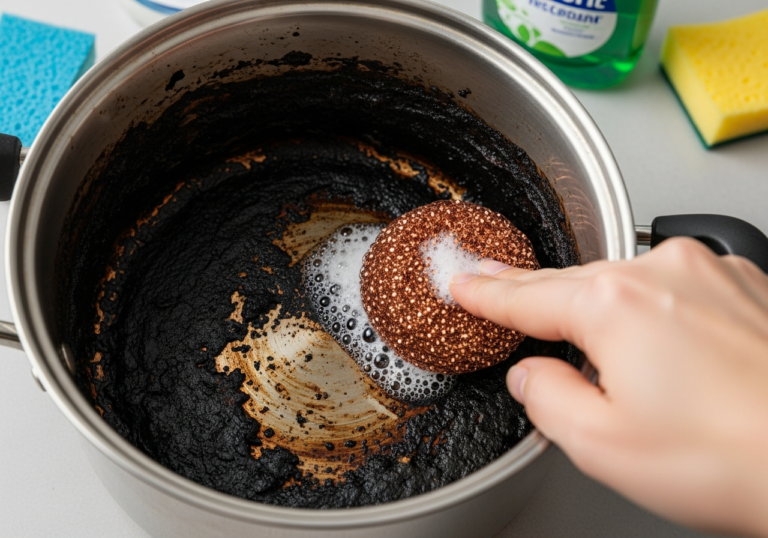
This is deglazing turned into cleaning. If the pot is still hot, pour in about a cup of water; it will erupt into steam and start lifting the char from the base while you scrape with a wooden spoon. If the pot has already cooled, fill it with water, add a generous splash of dish soap, and set it on a burner until it boils, then drop the heat and let it simmer for ten minutes. Heat and moisture collapse the carbonized sugar-and-protein matrix until the concrete-hard crust sloughs off into pourable sludge; for many burns, nothing else is needed.
Method 2: Vinegar and Baking Soda for Stubborn Black Crust
When boiling alone fails, run the acid-base reaction. Cover the burnt base with a thick layer of baking soda, then pour white vinegar over it; the mixture fizzes violently, and the released carbon dioxide helps pry the char off the metal. The real work happens next. Fill the pot further with very hot water and leave it alone for several hours, ideally overnight, while the alkalinity of the baking soda weakens the organic structure of the burn. By morning the residue gives way to an ordinary sponge.
Method 3: The Dryer Sheet Soak
A laundry staple rescues burnt casseroles and stainless pots. Submerge a fresh dryer sheet in warm water inside the pan and leave it for about an hour. The same conditioning agents designed to coat fabric fibers act as surfactants here, lowering the water’s surface tension so it penetrates the carbonized layer instead of beading off it. The crust turns soft enough to slide away. Wash the pan thoroughly with soap afterward, since laundry chemicals are not food-safe.
Method 4: Oxalic Acid Paste for Polymerized Oil and Heat Tint
Pantry tricks stall against brown, sticky oil that has baked black, usually on the sides or the exterior base. For that, a powdered cleanser containing oxalic acid, with Bar Keepers Friend as the classic example, is the gold standard: the acid attacks oxidation at a molecular level while micro-abrasives polish the surface. Make a paste with a little water, apply it to the stain, and let it sit for roughly a minute, no longer, because it can etch metal. Rinse and it is the only home method that reliably restores the mirror shine and erases the rainbow heat tint that follows a high-heat disaster.
Method 5: The Coarse Salt Scrub for Cast Iron
Cast iron rejects everything above: long boils and soapy-feeling soaks invite rust and strip seasoning. Instead, pour about a cup of coarse kosher salt into the warm skillet and scour with a folded paper towel or a dedicated rag. The salt grinds away char without harming the iron and soaks up grease as it works. When the salt turns black and the surface feels smooth, dump it, rinse briefly with hot water, dry the pan over a flame, and wipe on a thin coat of oil. For truly catastrophic burns, a chainmail scrubber or steel wool will reset the pan, but budget for re-seasoning.
Special Cases: Non-Stick and Enamel
Non-stick leaves zero margin. No steel wool, no abrasive powders, no metal scrapers. Simmer water with a little baking soda gently, never at a rolling boil, and nudge debris loose with a soft silicone spatula. If the crust lifts but the coating lifts with it, retire the pan; swallowing flakes of a damaged coating is a health risk no pot is worth. On enameled cast iron, skip the bleach many blogs suggest, since it dulls the gloss over time. Dissolve a scoop of powdered laundry detergent, whose enzymes digest starch and protein, in boiling water in the pot and soak overnight; the burn usually wipes away with a soft cloth the next day.
For scorched exteriors on stainless or aluminum pans, oven cleaner sprayed outside only, left for twenty minutes in a ventilated space, dissolves carbon fast. Four rules protect both the cookware and the cook:
- Never let oven cleaner touch a cooking surface, a wooden or plastic handle, or any non-stick pan.
- Preheat stainless with oil before food goes in; stuck-on sears are what burn.
- Keep cast iron at medium heat or below, since it holds and radiates heat far beyond that.
- Never run a non-stick pan on a high burner, empty or full.
| Method | Best for | Dwell time |
|---|---|---|
| Boil with dish soap | Fresh burns on stainless | 10 minutes simmering |
| Vinegar plus baking soda | Black crust on stainless | Hours to overnight |
| Dryer sheet soak | Casseroles, stainless pots | About 1 hour |
| Oxalic acid paste | Polymerized oil, heat tint | About 1 minute |
| Kosher salt scrub | Cast iron skillets | While warm |
Recovering a pan saves money and landfill, but a whole kitchen coated in grease film and limescale is a different project, and it is ours. Toronto Shine Cleaning resets cabinets, range hoods, appliances, and faucets as part of a kitchen deep clean; call or text (647) 424-0355 to book one. Pair it with recurring visits from a regular cleaner so the mess never rebuilds, and read what clients say on our reviews page. Before you bring any strong cleaner near dinnerware, review the CDC’s rules for cleaning and disinfecting food-prep areas at home, and keep products like oxalic acid or oven cleaner stored sealed and out of reach of kids and pets. Scrubbing marathons are real exercise, as the CDC’s benefits of physical activity summary notes, so pace yourself.
Burnt Cookware Questions
Is a burnt pot always salvageable? Stainless steel, cast iron, and enamel nearly always are. Non-stick is the exception: once the coating itself has been burned or is flaking, the pan should be discarded rather than cleaned.
Can I skip the soak and just scrub harder? Abrasive force before softening mostly moves you around. Every method above works by loosening the carbon layer first, so the final scrub takes seconds instead of an hour.
Why is the rainbow tint on my steel pan not scrubbing off? That discoloration is heat-induced oxidation, not food residue. Only an acid like oxalic cleanser changes it chemically; nothing mechanical will polish it away safely.
Is bleach fine for an enameled Dutch oven? It will remove stains, but repeated use dulls the glossy finish. An overnight enzymatic detergent soak achieves the same result without damaging the enamel surface.