









The Invisible Price of a Cozy Canadian Winter
The cold does most of its indoor damage quietly. Sealed houses and running furnaces strip moisture from the air until the environment inside your walls turns drier than a desert, and your body reports the loss first: a throat that tickles all day, a voice that croaks until mid-morning, skin that feels tight and itchy, lips that chap, knuckles that crack. Add the sudden snap of static from a doorknob and wooden furniture that creaks and splits as the season drags on. The CDC’s winter weather guidance captures how thoroughly the cold season reshapes life indoors, and dry air is the part nobody shovels.
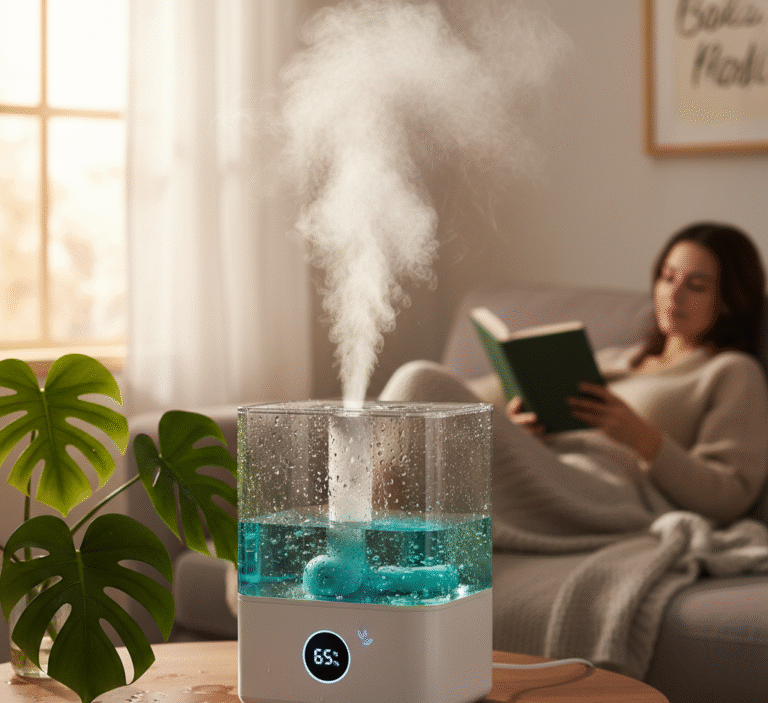
The fix is one small appliance that puts water vapor back where the furnace took it out. Run properly, a humidifier turns a harsh, parched house into a comfortable one. The word “run” is doing a lot of work there, because this machine never runs clean on autopilot.
Why the Number 30 to 50 Matters
Indoor comfort is usually discussed through relative humidity, which compares the moisture the air holds to the maximum it could hold at that temperature. Health experts put the comfort zone between 30 and 50 percent. Cold outdoor air carries almost no water, and once you heat it indoors, the percentage collapses into single digits. Parched air behaves like a sponge, pulling moisture from your skin and from the mucous membranes lining your nose, throat, and lungs. Those membranes are your first line of defense at trapping viruses and bacteria, so when they dry out, colds and sinus trouble hit harder and linger longer. Kept properly humid, they soothe coughs and ease congestion instead, which is why humidifier season overlaps with cold and flu season.
The Hidden Danger in the Tank
Every humidifier carries a reservoir of standing water, and standing water at room temperature is exactly where mold, mildew, and bacteria build an empire. An uncleaned unit then does something genuinely counterproductive: it aerosolizes whatever is growing inside and broadcasts a plume of microscopic contaminants into the air your family breathes. That can flare allergies and, in some cases, trigger a respiratory illness known as humidifier fever. The CDC’s overview of mold and your health explains why inhaled mold exposure is worth taking seriously. The same page on cleaning and disinfecting with bleach doubles as a reminder that disinfectants need correct dilution and a thorough rinse.
Which Machine Do You Have?
| Type | How it works | Trade-off |
|---|---|---|
| Evaporative | Fan blows air through a wet wick, releasing invisible cool mist that self-regulates as the room humidifies | The wick is consumable: minerals clog it, and neglect lets it harbor mold |
| Ultrasonic | A vibrating diaphragm shatters water into a visible cool mist; very quiet, no filter to buy | Anything dissolved in the water leaves with the mist, so tap water sprinkles white dust on every surface |
| Vaporizer | A heating element boils water, so the steam released is sterile and warm | Uses more electricity and poses a burn risk around small children |
| Whole-house | Built into the forced-air system, holding every room at a set level automatically | Costliest option, needs professional installation and upkeep |
If you own the ultrasonic kind, the tank is only half the story: use distilled water, because its minerals have been removed, so the mist stays pure and the dust never settles. Distilled water also stretches the life of an evaporative wick.
A Routine That Takes Minutes
- Daily: Empty the tank, rinse it, and refill with fresh water. Never just top up old water that has been sitting.
- Weekly descale: Unplug, separate tank from base, and soak both with equal parts white vinegar and water for at least an hour; the acetic acid dissolves the chalky crust. Gently brush the residue away.
- Weekly disinfect: Swirl a mix of one teaspoon of household bleach per gallon of water in the tank, hold it for about twenty minutes, then rinse obsessively until no bleach smell survives. A 3 percent hydrogen peroxide solution works the same way.
- Always finish dry: Air-dry every part completely before reassembly, because a dry surface cannot grow mold.
Placement and measurement seal the deal. Sit the unit on a level, water-resistant surface a few feet off the floor, away from walls, electronics, and wooden furniture, with room for airflow. Then spend a few dollars on a hygrometer, the little device that reads room humidity, so you can confirm you are inside the 30 to 50 percent band. Over-humidifying is a real mistake too: too much moisture beads on windows and walls and grows the very mold you bought the machine to outmaneuver.
Breathe Easy, Live Spotless
A clean humidifier protects the air you breathe; a clean home protects everything else. Toronto Shine Cleaning covers both angles with scheduled regular cleaning and seasonal deep cleaning for your home, serving neighbourhoods across the city as listed on our locations page. Call (647) 424-0355 to book, or start with an online quote at your convenience.
Frequently Asked Questions
How often should a humidifier be cleaned? A quick empty-rinse-refill belongs every single day, while the full descale-and-disinfect routine should happen weekly through the whole season you run the machine.
What is the white powder on my shelves? That is your tap water wearing a disguise. Ultrasonic models atomize dissolved minerals along with the water, and they settle as fine dust. Switching to distilled water stops it.
Can a dirty humidifier really make me sick? Yes. Standing water breeds mold and bacteria, and the mist launches them into the room air, which can trigger allergies and, in some cases, a respiratory illness called humidifier fever.
Is higher humidity better if dry air is the problem? No. Above the 30 to 50 percent range, condensation forms on windows and walls and invites mold growth. A cheap hygrometer keeps you in the safe band.