




Toronto Shine Cleaning

Toronto Shine Cleaning Featured on Forbes Vetted
TorontoShineCleaning.ca featured on Real Homes
TorontoShineCleaning.ca featured on Business Insider
TorontoShineCleaning.ca featured on Homes and Gardens (h&g)
TorontoShineCleaning.ca featured on Yahoo
TorontoShineCleaning.ca featured on Apartment Therapy
TorontoShineCleaning.ca featured on The Kitchn
TorontoShineCleaning.ca featured on TomsGuide
TorontoShineCleaning.ca featured on StyleDemocracy
TorontoShineCleaning.ca featured on FamilyHandyman
TorontoShineCleaning.ca featured on TheSpruce
TorontoShineCleaning.ca featured on Curiocity
Edit Template

LinaDaSilva

Writer & Blogger

Baseboard Heaters: The Step-by-Step Heater Cleaning Routine

Baseboard heaters are the silent, often ignored workhorses of residential heating. In many regions, particularly in older apartments and homes where retrofitting ductwork for forced air is structurally impossible, these metal units are the primary source of warmth. They sit unobtrusively at the floor level, usually beneath windows, occupying a visual blind spot that allows them to be easily disregarded until the first cold snap of autumn arrives. It is in that moment, when the thermostat is finally turned up, that the distinct, acrid scent of burning dust fills the room, signaling months of neglect. This smell is not merely a nuisance; it is the olfactory evidence of a system that is choked, inefficient, and potentially dangerous. While baseboard heaters are mechanically simple—essentially a heating element inside a metal pipe surrounded by aluminum fins—their placement and design make them magnets for the worst kind of household debris. Maintaining them is not just a matter of cleanliness; it is a critical component of energy efficiency, air quality, and home safety.

Baseboard heaters

How Does it Work?

To understand why cleaning these units is so vital, one must first understand the physics of how they operate. Baseboard heaters rely on convection. Unlike a furnace that uses a blower fan to force air through vents, a baseboard heater is a passive engine. It utilizes the natural law that hot air rises and cold air sinks. Cold air from the floor creates a vacuum effect as it is drawn into the bottom of the heater. It passes over the heating element, warms up, and then rises out of the top of the unit, displacing the cooler air in the room. This cycle creates a continuous, silent current of air circulation. However, this same current acts as a low-level vacuum cleaner for the home. As the air is drawn into the bottom of the unit, it carries with it everything that settles on the floor: pet hair, human dander, textile fibers, and general dust. Because the heater is located at the lowest point of the room, it inhales the heaviest concentration of particulate matter.

Once this debris enters the metal housing, it encounters the heat exchanger. This component consists of a central pipe surrounded by hundreds of thin, sharp aluminum fins. These fins are designed to maximize surface area, allowing the heat from the pipe to transfer to the air as efficiently as possible. However, the tight spacing between these fins makes them a perfect trap for debris. The dust and hair do not simply pass through; they get caught on the jagged edges of the aluminum and wedged between the plates. Over time, this buildup forms a thick, felt-like blanket of grey fuzz. This blanket acts as an insulator. The entire purpose of the fins is to release heat, but the dust layer traps that heat against the metal. The result is a heater that has to work significantly harder and run for longer periods to raise the room temperature, leading to a direct and noticeable spike in electricity bills. You are essentially paying to heat the dust, not the air.

How baseboard heaters work

Security

Beyond the financial cost of inefficiency, there is a legitimate safety concern. The heating element inside an electric baseboard heater gets incredibly hot. While the metal housing remains touchable, the internal components reach temperatures high enough to singe organic matter. The “burning smell” that permeates a home in October is literally the combustion of the dust and hair that has settled on the element during the summer months. While most of this dust simply carbonizes and floats into the air as soot, a heavy accumulation of lint—which is highly flammable—poses a fire risk. If a piece of paper, a curtain, or a thick clump of pet hair falls directly onto the element, it can ignite. This risk is compounded by the fact that baseboard heaters are often hidden behind furniture or drapes, meaning a small smolder could go unnoticed until it becomes a significant problem.

The health implications of a dirty baseboard heater are also frequently underestimated. As the unit heats up and burns off the accumulated dust, it releases particulate matter and chemical byproducts of combustion back into the room’s airflow. For individuals with asthma, allergies, or respiratory sensitivities, this creates a toxic environment. The convection current that heats the room also serves to circulate these allergens efficiently, ensuring they remain suspended in the breathing zone. Furthermore, the dark, warm environment inside a heater that is not in use during the spring and summer can become a harbor for mold or pests. Cleaning the unit is the only way to break this cycle of recirculating filth.

Cleaning a baseboard heater requires a specific methodology because the internal components are delicate and sharp. The aluminum fins are incredibly pliable; they can be bent by a stray vacuum attachment or a clumsy finger. If the fins are bent flat against each other, the airflow is blocked, and the unit’s efficiency drops to zero in that spot. Therefore, the first step in any cleaning regimen must be safety—both for the user and the machine. The power must be turned off at the main breaker panel. Simply turning the thermostat down is insufficient, as a sudden drop in temperature could trigger the unit to activate while your hands are inside. A voltage detector is a handy tool to confirm the power is truly dead before opening anything.

Safety when using a baseboard heater

Vacuum Cleaner

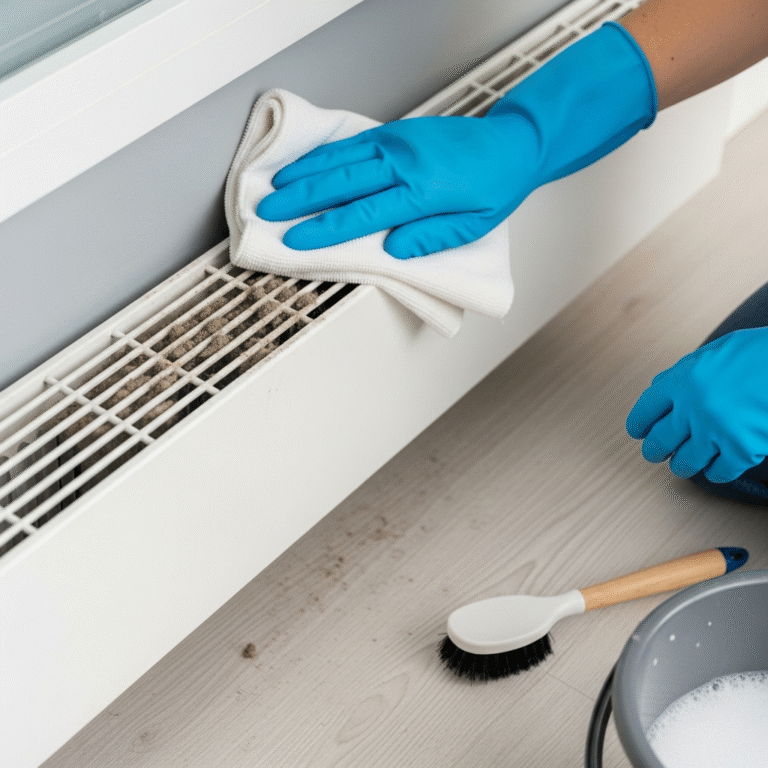
The exterior cover, or the faceplate, is usually removable, though the difficulty varies by model. Removing this panel provides access to the fins and the element. The initial attack on the dust should always be dry. Introducing water to a caked-on layer of dust creates mud, which is nearly impossible to remove from the tight crevices of the fins. A vacuum cleaner with a strong suction and a crevice tool is the best starting point. The goal is to suck out the loose debris from between the fins without dragging the hard plastic of the vacuum nozzle across the delicate aluminum. A soft bristle brush attachment can be used on the faceplate, but the internal fins require a gentle touch.

For the dust that the vacuum misses—and there will be plenty—compressed air is the most effective tool. However, blowing compressed air into a dirty heater will result in a mushroom cloud of dust exploding into the room. This step requires strategy. It is best to hold a vacuum hose nozzle near the area you are blasting to catch the airborne plume immediately. The compressed air should be directed parallel to the fins, blasting the debris out from the back of the unit toward the front. This dislodges the stubborn, felted dust that wedges itself deep near the heating rod. It is a messy process, often requiring a mask and subsequently vacuuming the surrounding floor, but it is the only way to truly clear the airway.

Once the dry dust is removed, the issue of grime remains. Kitchen baseboard heaters are often coated in a sticky layer of airborne cooking grease, while bathroom units suffer from hairspray residue and humidity-induced rust. Cleaning the fins with liquid is dangerous due to the risk of electrical shock and corrosion, so it should be done sparingly and only when the unit is de-energized. A damp cloth with a mild degreaser can be used to wipe the faceplate and the top of the fins, but spraying cleaner directly into the core of the unit is ill-advised. If the fins are sticky with grease, a soft toothbrush dipped in a cleaning solution can be used to gently scrub them, provided the area is dried thoroughly afterward. Rust on the exterior housing is a common aesthetic complaint. Since baseboard heaters are made of steel, they rust easily in damp environments. Sanding down the rust spots and repainting with a heat-resistant metal paint can make an old unit look brand new, but one must ensure the paint is rated for high temperatures to avoid peeling and chemical odors when the heat turns on.

using the vacuum cleaner on the baseboard heater

Distance

The placement of furniture and lifestyle habits contribute significantly to the state of these heaters. A common mistake is treating the heater as a shelf or pushing a sofa directly against it. Manufacturers typically recommend a clearance of at least twelve inches in front of the heater and six inches above it. When furniture blocks the unit, the heat cannot escape. This not only ruins the efficiency of the convection current—leaving the rest of the room cold—but it also traps extreme heat inside the unit. This can trip the thermal safety limit switch, causing the heater to shut off completely, or it can damage the finish on the furniture. Drapes are particularly problematic. Floor-length curtains should never be used above a baseboard heater unless they are hemmed to float several inches above the intake. If the fabric rests on the heater, it acts as a lid, trapping the heat and creating a massive fire hazard.

Electric Baseboards and Hydronic

The distinction between electric baseboards and hydronic (hot water) baseboards is worth noting, though the cleaning principles remain similar. Hydronic units are connected to a central boiler and use hot water circulating through a copper pipe to generate heat. They stay warm longer after the system shuts off and generally operate at a lower surface temperature than electric models, making them slightly safer regarding fire risks. However, the fins on hydronic units are just as susceptible to dust clogging. The primary difference in maintenance is that hydronic units do not have the same risk of electrical shock inside the fin area, although the water pipes can leak. If you see green corrosion on the copper pipes of a hydronic unit, it indicates a slow leak that needs professional plumbing attention, not just cleaning.

Straightening the fins is a detail-oriented task that separates a quick clean from a restoration. Over years of vacuuming and impacts from children’s toys, the aluminum fins often get crushed. When fins touch each other, air cannot pass through. inexpensive tools called “fin combs,” originally designed for air conditioners, can be used to gently comb the aluminum blades back into parallel alignment. This simple mechanical adjustment restores the surface area and airflow, significantly improving the heat output of the unit. It is a tedious process, but one that pays dividends in comfort and energy savings.

Electric Baseboards and HydronicThermostat

Another aspect of baseboard maintenance is the thermostat. While not part of the cleaning process, the thermostat dictates the heater’s behavior. Older bi-metal thermostats are notoriously inaccurate and can cycle the heater on and off rapidly, which accelerates the accumulation of dust by constantly creating and stopping convection currents. Upgrading to a digital thermostat provides a more steady, consistent heat, which creates a more stable airflow and reduces the violent “on-off” cycles that tend to kick up more dust. Furthermore, smart thermostats allow for better scheduling, meaning the heaters aren’t running—and inhaling dust—when no one is home.

Aesthetics

The aesthetic condition of the heater often drives the desire to clean it. Over time, the white powder-coat finish yellows due to heat exposure, or gets scuffed by shoes. It is possible to remove the front covers entirely and take them outside for a deep clean and spray paint. Using high-heat enamel spray paint is essential; standard spray paint will smell terrible and eventually crack under the thermal expansion and contraction of the metal. Renovating the covers this way is a cost-effective alternative to replacing the entire unit, which requires an electrician. However, one must never paint the heating element or the fins themselves, as the paint acts as an insulator and will burn off, creating toxic fumes.

There is also the consideration of the wall behind the heater. Because of the upward airflow, the wall directly above a baseboard heater often develops “ghosting” or soot stains. This is caused by the dust particles being carbonized by the heater and then plated onto the drywall by the rising air current. Regular cleaning of the heater reduces this, but once the stains are there, they are difficult to scrub off. Often, the wall needs to be sealed with a stain-blocking primer and repainted. Keeping the heater clean is the only preventative measure for these unsightly wall streaks.

Maintenance

Ultimately, the baseboard heater is a system that demands respect. It is a simple device that performs a complex thermodynamic function, and it does so in the dirtiest part of the room—the floor. Ignoring it does not make it go away; it simply converts it into an energy-wasting, smell-producing, allergen-circulating liability. By integrating baseboard cleaning into a seasonal routine—ideally once before the heating season begins and once after it ends—homeowners can ensure their air is cleaner, their bills are lower, and their home is safer. It transforms a dusty eyesore back into the efficient, silent servant it was designed to be.

performing on baseboard heaters

Maintaining a home involves managing a multitude of systems, from the visible surfaces to the hidden mechanical components like baseboard heaters. It is a labor-intensive process that requires time, specific tools, and a detailed understanding of how different areas of the home interact. When the list of maintenance tasks becomes too long, or when the dust in the hard-to-reach places feels overwhelming, professional support is the solution. Toronto Shine Cleaning offers a level of service that addresses the deep-seated grime that standard tidying misses. Just as we have explored the meticulous care required for your heating systems, Toronto Shine Cleaning applies that same rigorous attention to detail to your entire living space. Whether it is removing the dust that affects your air quality or scrubbing the corners you can’t reach, their professional team has the expertise to reset your home’s cleanliness. 

Baseboard Heaters routine day

Get a Quote Now!

Toronto Shine Cleaning is your go-to cleaning service in Ontario, offering top-notch cleans with a side of convenience. We’re all about making your home sparkle, and when we’re not doing that, we’re sharing easy, practical tips to help you keep things tidy. Simple, effective, and hassle-free – that’s cleaning, the Toronto Shine Cleaning way.

Reach Out to Us

Edit Template